
Criminal Cases in the Howard County Courts
Iowa District Court has general criminal jurisdiction in Howard County. District judges handle felony matters. District associate or associate judges and magistrates hear misdemeanors, initial appearances, traffic matters, and other work assigned by Iowa law within the same unified court. Cresco, Riceville, and Elma do not run separate municipal criminal-court databases. A Howard County case filed by the County Attorney belongs in the state District Court system even when the event began with a city officer or county deputy.
The Howard County Clerk of Court keeps the Howard County criminal case file. That role includes the docket, charging papers, orders, hearings, pleas, disposition, judgment, sentence, costs, and appeal entries when public. The Howard County Sheriff keeps arrest and jail records instead. Readers who need the event before charges were filed can use the separate Howard County arrest history channels, but a certified court outcome must come from the Howard County Clerk.
Howard County Criminal Clerk Counter
The Howard County Clerk works inside the Howard County Courthouse at 137 N Elm St, Cresco, IA 52136. Call 563-547-9206, fax 563-547-9265, or email countyclerk.howard@iowacourts.gov. The official Howard County contacts page posts courthouse hours of Monday through Friday, 8:00 a.m. to 4:30 p.m. This is the local Howard County counter for criminal dockets, public filings, older records, certified dispositions, and questions about a Howard County case that does not appear online.
The Iowa Judicial Branch Howard County Clerk page confirms the court contact and Judicial District 1 setting.
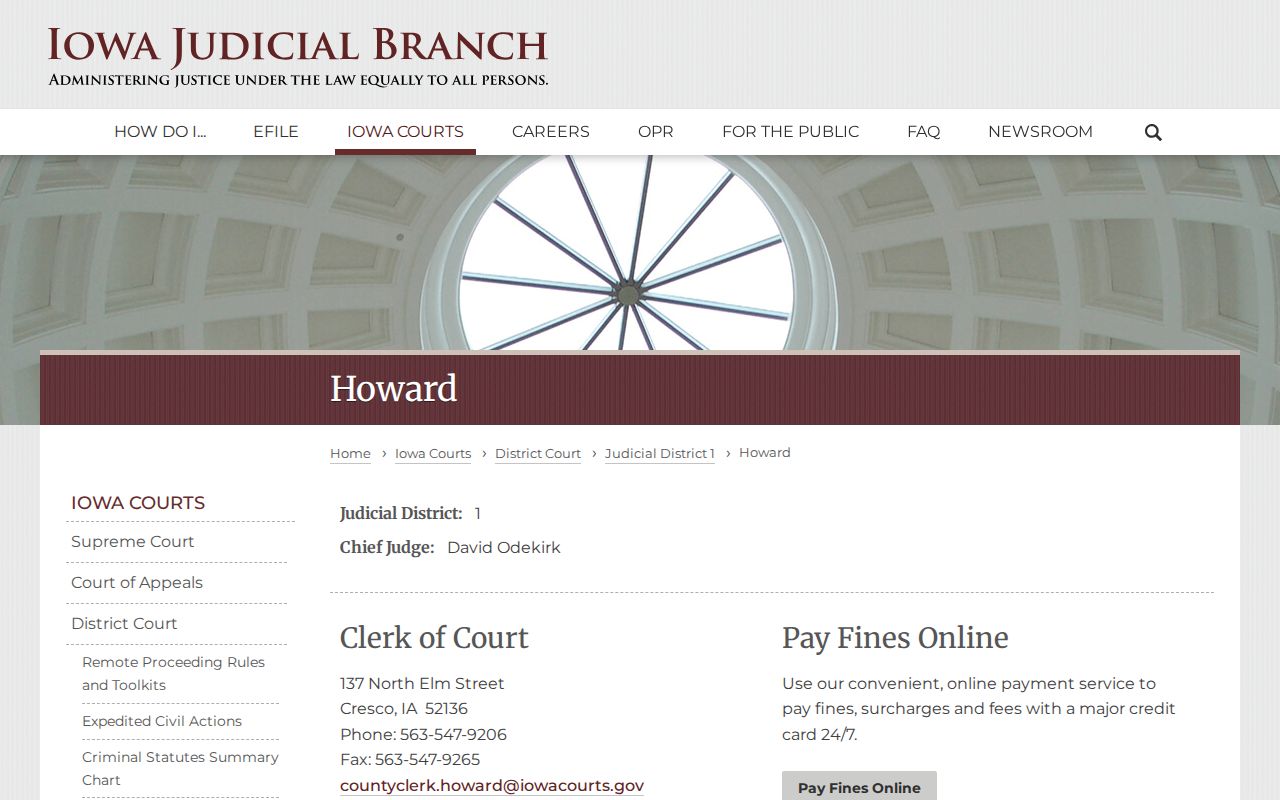
The Howard County Clerk page is the official route for Howard County case records, while the statewide administrative public-record officer does not supply District Court case documents. Scheduling questions use the district scheduling line at 319-833-3332. Plain-copy, certified-copy, and search fees were not posted in the Howard County research, so ask for the current amount before ordering.
Note: The Howard County Recorder handles land and vital records, not the District Court criminal case file.
How to Search Case Records
Iowa Courts Online is the public starting point for a Howard County criminal docket. It is an index, not a complete document library. Use an exact case ID when possible. A name can work, but spelling, punctuation, shared names, older indexing, confidentiality, and the wrong county selection can alter the result.
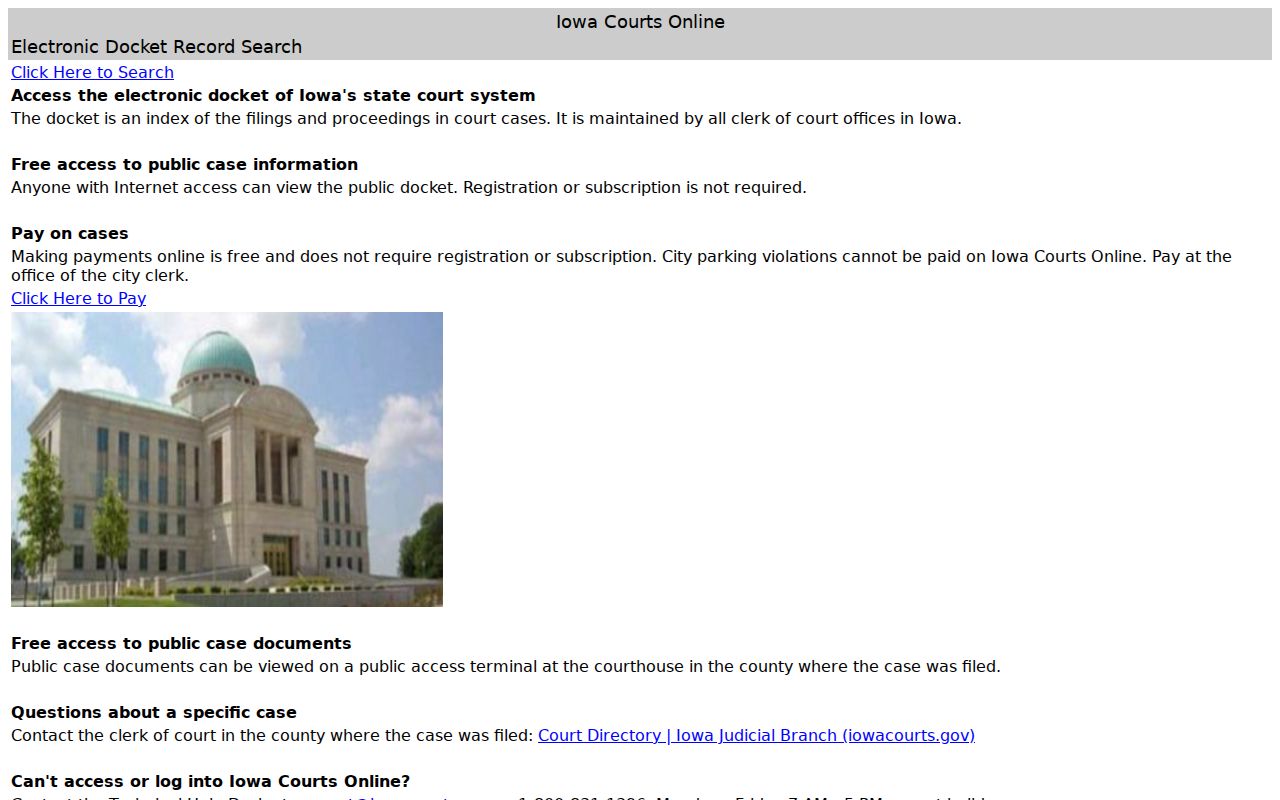
The official Howard County search route lets readers narrow a Howard County result before opening its docket:
- Choose Trial Court and open the public case search.
- Enter the exact case ID or search the party name with care.
- Select Howard as the county and apply a criminal case-type filter when useful.
- Compare the charge, filing date, status, and disposition on the matching docket.
- Contact the Howard County Clerk for a missing filing, certified copy, or older case.
| Field label | Type | Required | Howard County use |
|---|---|---|---|
| Trial Court / Appellate Court | Navigation | Yes | Choose Trial Court for a local criminal case |
| Case Search | Tab or link | Yes | Open the public index search |
| Case ID | Text | Alternative | Use the exact Iowa case number when known |
| Name | Text | Alternative | Check spelling, spaces, and identity details |
| County | Dropdown | Narrowing | Select Howard for cases filed here |
| Case type | Filter | Optional | Use FE, AG, SR, SM, OW, NT, ST, or a related code |
| Search | Button | No | Run the Howard County query |
| Reset / Clear | Button | No | Remove the prior search criteria |
Note: A Howard County name match still needs confirmation through charge, filing date, case type, and disposition.
Howard County Criminal Docket Codes
Howard County docket codes describe the Howard County case level or subject. FE marks a felony. AG means aggravated misdemeanor, SR serious misdemeanor, and SM simple misdemeanor. OW identifies an operating-while-intoxicated case. NT and ST distinguish nonscheduled and scheduled traffic matters. These Howard County labels help separate similar names and filings, but the code alone does not state whether the charge ended in a conviction.
- Complaint
- A sworn allegation that can begin a Howard County case or support probable cause.
- Trial information
- The Iowa prosecutor's formal charging document for an indictable offense.
- Disposition
- The outcome entered for a charge, such as dismissal, acquittal, or conviction.
- Deferred judgment
- An Iowa court delays adjudication while the person completes ordered terms.
- Mittimus
- A court order committing a sentenced person to custody.
A Howard County booking label is preliminary. The filed charge and final result on the court docket are the better sources for what prosecutors pursued and how the judge resolved it.
What the Case File Shows
A Howard County criminal case file records Howard County procedure, not just an accusation. Searchers should compare each charge with its own status because one count may be dismissed while another reaches judgment. The Howard County public docket can also list hearings, attorneys, court events, sentence entries, and money owed. Confidential documents and private identifiers do not appear in an ordinary public view.
| Case Number & Court | Howard County, case type, title, filing date, and current status |
|---|---|
| Charging Document | Complaint, trial information, or other public filed charge with statute and level |
| Docket Entries | Dated filings, orders, event descriptions, judicial officer, and filing party |
| Hearing Dates | Scheduled date, time, hearing type, and later calendar changes |
| Disposition & Judgment | Outcome for each charge, plea or verdict, dismissal, and judgment |
| Sentence & Conditions | Confinement, probation, fine, surcharge, costs, restitution when ordered, and payment balance |
Howard County court debt is not the same as bond. Bond supports release and future appearance. The Howard County financial ledger instead reflects fines, surcharges, court costs, restitution when ordered, payments, and a remaining balance tied to the case.
Howard County Court Documents Online
The public index may list a Howard County filing without offering its PDF. Iowa eFile and EDMS handle Howard County electronic filing and document access, and an account may be required. Public access can differ by document, user role, and confidentiality rule. If the Howard County docket identifies the filing but no download appears, record the case ID, event date, and document title before contacting the Clerk.
The Iowa Judicial Branch eFile and EDMS page explains the statewide document system used for Howard County cases.
EDMS does not displace the Howard County Clerk. Ask the Howard County Clerk about a public document that cannot be downloaded, an older file, access to an available courthouse record, or certification. For a certified Howard County disposition, state that need at the start because an ordinary screen print is not the same product.
Note: A visible Howard County docket event does not guarantee that its underlying filing is open for remote download.
Stages of a Criminal Case
A Howard County case may begin with an arrest or summons. The initial appearance addresses rights, counsel, custody, and release. The County Attorney then proceeds through a complaint, trial information, or grand-jury route as Iowa law allows. Arraignment is the stage where the charge is formally addressed and a plea is entered. Discovery, motions, and a pretrial conference follow before a plea, bench trial, or jury trial resolves the contested charge.
Case flow: Charges Filed › Arraignment › Pretrial › Plea or Trial › Disposition › Sentencing
Judgment and sentence do not always end the Howard County record. Post-trial motions, an Iowa appeal, Howard County court-debt payments, probation filings, or a later revocation matter can add docket entries. The Howard County portal result may show those events before every public document is ready online. Appellate entries remain part of the statewide court layer rather than a new Howard County municipal system.
Howard County Criminal Charging Path
The Howard County Attorney reviews law-enforcement investigations and decides what state charges to file. The Howard County office directory places that office at 137 N Elm St and lists 563-547-9202. Police allegations and jail booking charges do not control the final court pleading. A summons case may create a Howard County docket without a jail booking, while release without a filed charge can leave no Howard County criminal case in the Clerk's system.
Once filed, the Howard County Clerk records the public procedural trail and the State of Iowa appears as the prosecuting party. A defendant who seeks appointed counsel does so through the court and completes financial eligibility material. The State Public Defender structure is appointment-based; it is not the public-record counter. General Howard County record requests still belong with the Howard County Clerk.
Note: The Howard County Attorney prosecutes the case, while the Clerk preserves the court record and supplies public copies.
Access & Restrictions
Howard County court dockets are generally open, but Howard County public access has limits. Most juvenile court files are confidential under Iowa Code §232.147. Sealed or expunged records, victim and minor details, medical facts, account numbers, and other protected identifiers may also be withheld. Iowa Court Rules chapter 16 and Judicial Branch policy govern Howard County court-file access in addition to the state's open-records law.
A missing Howard County name result can reflect spelling, an older index, a restricted case, expungement, or the wrong county. Call the Howard County Clerk rather than treating the blank result as proof. Iowa Code chapter 901C provides event-specific expungement for qualifying matters, but no single Howard County order guarantees that every law-enforcement or DCI record disappears. The broader Howard County criminal history overview explains those separate record systems.
Howard County Federal Criminal Cases
Federal cases arising in Howard County use the U.S. District Court for the Northern District of Iowa, not the Howard County District Court docket. Search them through PACER, the federal judiciary's account-based case-record service. Its current fee schedule applies, and federal rules ordinarily waive quarterly charges below the judiciary's stated threshold. A state Iowa Courts Online search will not return this separate federal docket.
The official PACER portal is the record source assigned to Howard County federal criminal case research.
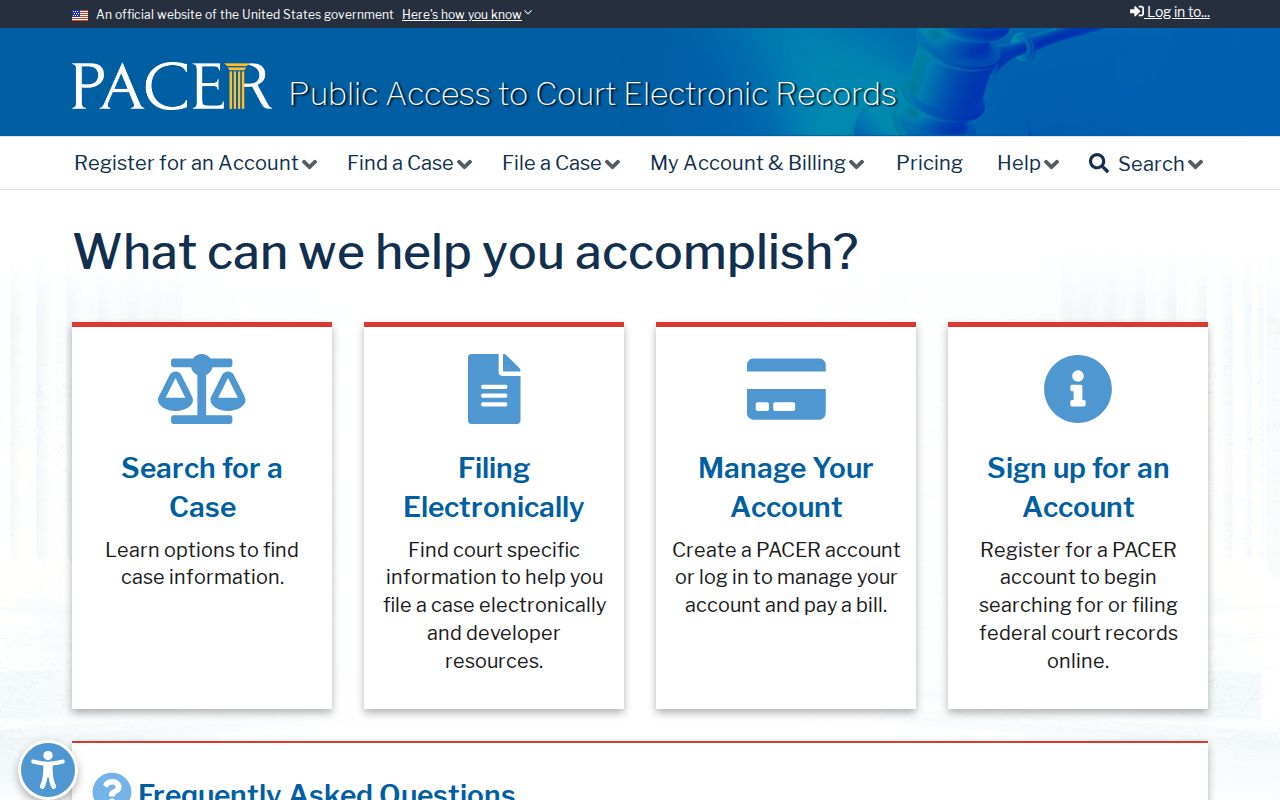
PACER confirms the difference between court systems. The Howard County Clerk supplies Iowa District Court case documents, while the federal court keeps Northern District filings. Federal custody also belongs to the Bureau of Prisons layer rather than the Howard County jail or Iowa DOC search.